COMPANY PROFILE
Yijia Hydraulic Machinery Co.,Ltd.was established in March 2013 and is a sole proprietorship.Our company is based in Suizhou,known as China's"Capital of Vehicle Modification”.We specialize in a single product line:hydraulic oil tanks(made of carbon steel and aluminum alloy)and hydraulic power units.
At present,we hold a 60% share of the high-end oil tank market across most regions in China, namely, Central China,East China, South China,and North China.Our key clients include XCMG Group, Zoomlion, Sany Heavy Industry, CREC(for tunnel boring machines), Hubei Jiaheng Technology Co.,Ltd., Shaoguan Crane Factory Co.,Ltd.,Henan Juntong Vehicle Co.,Ltd., Tai'an Furukawa Unic Crane Co., Ltd.,Hubei Huawei Special Vehicle Co.,Ltd., Shenyang Deheng Equipment Co.,Ltd., and other enterprises.
Main Equipment and Technique
Main Equipment:laser cutting machines,CNC press brakes,2 German KUKA robots,12 Chinese robots, one pickling and phosphating production line,and two powder coating and baking production lines. Besides,CNC necking machines, CNC forming machines, CNC lathes, CNC milling machines,CNC multi-head drilling machines and radial drilling machines are all available.Our company features advanced welding technologies including MIG/MAG welding, laser beam welding, and TIG welding. A complete streamlined process is established for our products to be machined, cut, sprayed, and assembled.
In August 2016,we pioneered a special internal processing technique for our products, which completely resolved the long-standing challenge of maintaining tank cleanliness. To date, no other Chinese manufacturer has adopted this technique. Our products can perfectly withstand estructive 90°bending tests and fire tests. The full-range auto- controlled production ensures both consistent quality and efficient delivery, which has become our biggest competitive advantage.
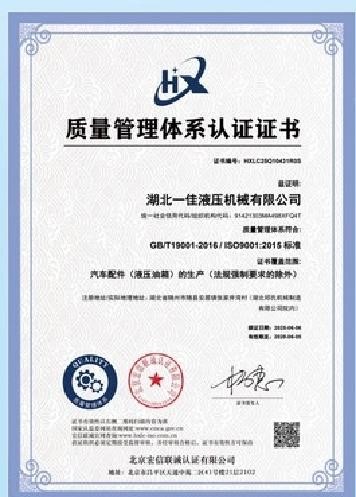
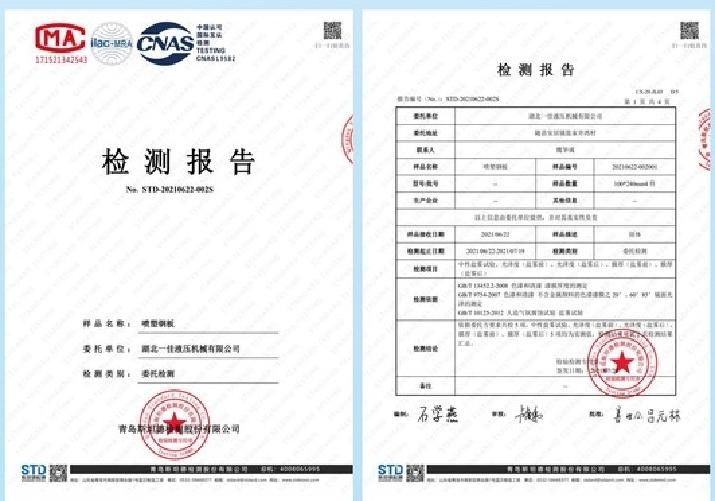
Quality Assurance
Main achievements in Quality Management
1. Our company has been involved in the hydraulic oil tank and hydraulic power unit business since 2013.Since the first welding robot was put into operation in January 2015,we have completely abandoned the traditional seam welding process, resulting in a significant improvement in welding quality.After the introduction of KUKA arc welding robots in 2016,welding speed was increased and welding quality was ensured.Thanks to new technologies,the welds have achieved optimal aesthetics.The number of welds for one oil tank is reduced from 9 to only 3.Under the coordination between the welding fixture and the positioner,all 3 welds can be completed in a single pass,minimizing the number of arc strikes and crater cracks.This advanced welding process has become our second largest competitive advantage.
2. Current quality control measures include four parts,namely,self-inspection, mutual inspection,two airtightness tests,and process inspection by dedicated quality inspectors. Mutual inspection and the airtightness tests are highlighted as follows. Mutual inspection means that work completed in the previous process is inspected in the subsequent process on the production line.If a quality issue in the previous process is missed and carried over to the subsequent process,it will be detected there, and operators of the previous process will be promptly notified for correction.For each case identified by the subsequent process,a reward equivalent to 2%of the product value is granted,whereas operators of the previous process are subject to a penalty of 4%of the product value.If the current process fails to inspect the previous process properly and the defect passes to the next process,where it is detected,the current process shall bear the same quality penalty as the previous process.In this case, should the current process neglect inspection of the previous process's work,it will forfeit the reward originally owed to the previous process and assume its quality penalty.This rule applies to all processes on the production line.
The two airtightness tests are: first,testing of all welded joints,and second, post-assembly testing of all components during the weld finishing process.